
Custom Die-Cut Foams and Silicones
Cushioning, sealing, gasketing, absorbing, vibration damping, and gap-filling are just a few of the applications where die-cut foam, silicone, and sponges are utilized. Marian die-cuts foams of different density, thickness, and composition based on the requirements of your application. We also have the capability to laminate the foam material with adhesive and other materials to create a more dynamic part.
Marian sources a large variety of closed-cell and open-cell die-cut foam and silicone materials. Stocking many of these materials allows us to provide samples and prototypes rapidly, often beating our competitors. We maintain strong relationships with industry-leading suppliers including Rogers PORON® foams, Rogers BISCO® Silicone Foams, Saint-Gobain, Nitto, and Armacell.
Contact us today for a material sample or quote.
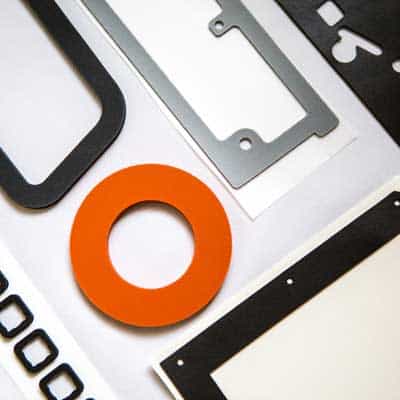
Commonly Die-cut Foam, Silicone, and Sponge Materials
- Rogers BISCO® silicone foam
- Norseal® Silicone, Diversified Products
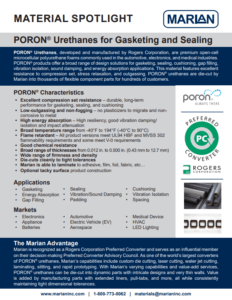
- Rogers PORON® urethanes
- Rogers PORON® AquaPro™
- Saint-Gobain Norseal® Polyurethanes
- EPDM, SBR, Neoprene blends
- LDPE/polyether sponge or foam
- PVC foams
- Electrically conductive
- Santoprene™ (TPV)
- Reticulated/filter foam materials
- Acoustic insulation foam
Foam Options with Marian
- Material density and thickness
- Open cell vs. closed cell
- Resistance to chemicals and UV exposure
- Adhesive backing
- Lamination to other substrates
- Final packaging: loose parts; on a liner; provided on a roll
- Tight tolerance and high-volume manufacturing, if required
Applications
- Sealing out moisture, dirt, debris
- Gasketing
- Gap filling
- Cushioning
- Vibration damping, noise deadening
- Impact protection

Blog Posts
 PORON® EVExtend For Use In EV/HEV Li-ion Pouch Cell Batteries
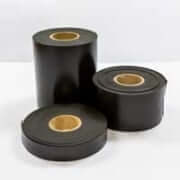 Compression Force Deflection Demonstration of PORON and BISCO Foams
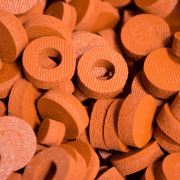 Open Cell Foam or Closed Cell Foam: Which is Better?
 3 Questions About Foam Compression Set Resistance
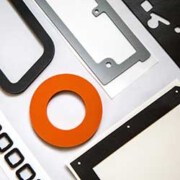 Closed Cell Neoprene Sponge and Blends
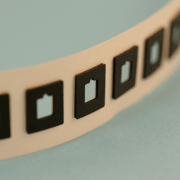 Closed Cell EPDM Sponge
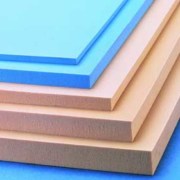 PORON® AquaPRO™ 37 - SOFT Foam, Water Sealing Solutions
Frequently Asked Questions About Custom Die Cut Foam
What makes custom die cut foam a good choice for my product?
Custom die-cut foam components provide a clean, safe, and simplified assembly process. Die-cut foam components can be provided kiss-cut on rolls, cut into singluated pads, packed loose, and more depending on the final application.
Parts can also be designed with assembly aids like pull-tabs and extended liners or can be integrated into automated assembly processes.
Can you help me select the right material for my application?
Part of Marian’s processes include working with customers to understand their application including the environment it will perform, what it will be exposed to, what it needs to withstand, and more. After we have answers to all the important questions, a Sales Engineer will recommend materials with the correct characteristics, price point, and availability.
How does foam die cutting improve product performance?
Implementing die cut foam parts offers a consistent, uniform application. The die-cut parts Marian produces are all checked to ensure they meet the customer provided tolerances and pass our quality inspection standards. Choosing dispensed or hand-cut materials doesn’t allow for the same consistency and reliability as a die cut part.
Can you provide samples for testing before a large order?
Marian maintains an inventory of a wide variety of thin, flexible materials including foams which allows us to provide samples and prototypes in as little as 24-hours depending on material availability.
Along with this inventory, we have also established strong partnerships with premier material suppliers including Rogers Corporation, 3M, tesa®, Polymer Science, Brightview Technologies, and much more that can also provide samples of materials we don’t immediately have available.
How does the die-cutting process ensure high precision?
Marian’s core converting capability is rotary die cutting, which is often done using hard tooling like metal dies. When cutting custom parts using a metal die, we’re able to manufacture parts with more consistency and while also holding a tighter tolerance.
Other converting processes such as laser cutting, waterjet cutting, and plotter cutting are also reliable methods for parts using thicker materials, parts with very specific, intricate, or larger geometries. These process all require a CAD file in .dxf or .dwg format to deliver precise finished parts.